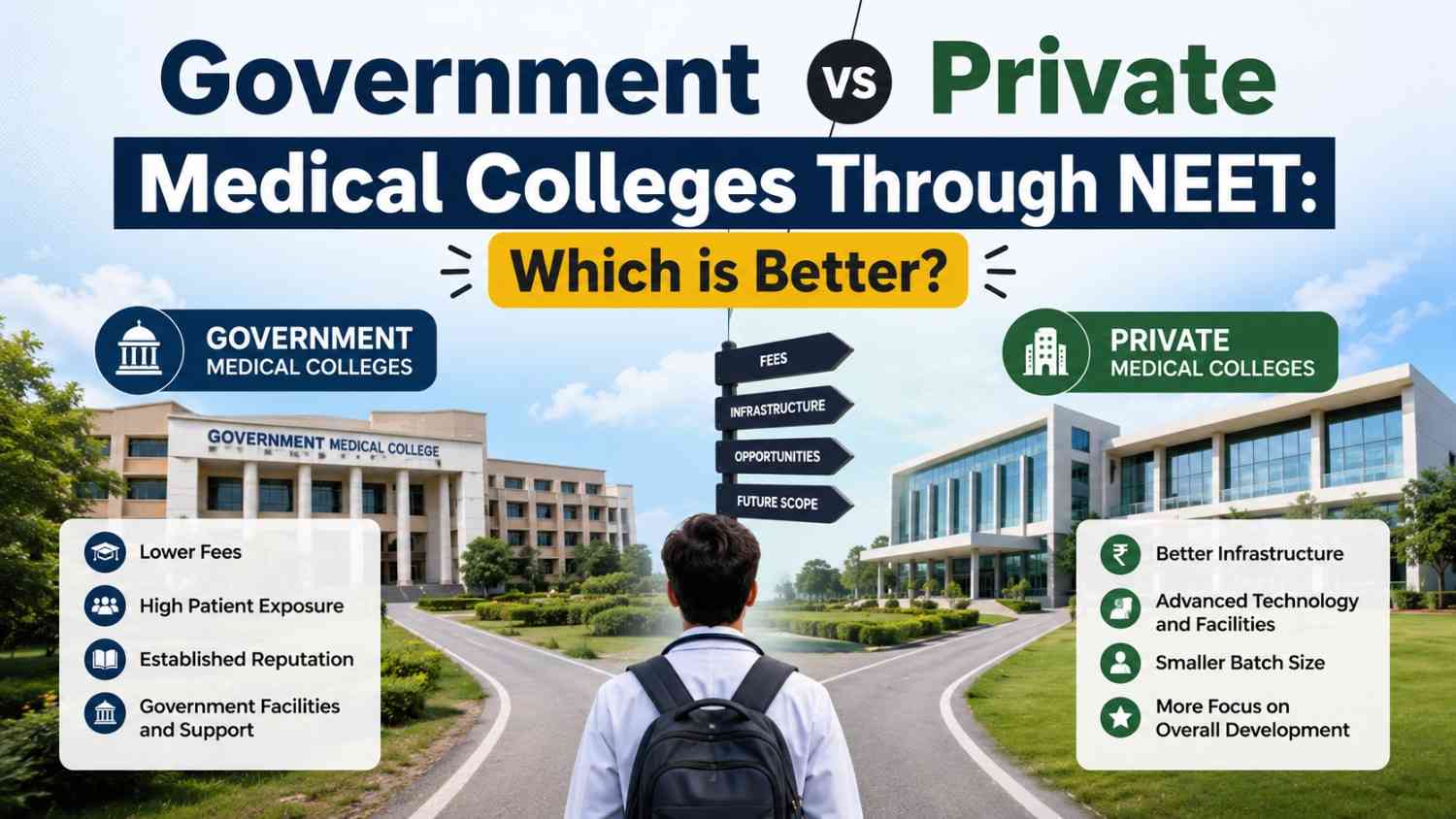
Choosing a medical college is one of the most important decisions for every NEET aspirant. After clearing the National Eligibility cum Entrance Test (NEET), students often face a common dilemma: Should I choose a Government Medical College or a Private Medical College?
Both options have their own advantages and challenges. While government colleges are known for affordable fees and strong clinical exposure, private colleges offer modern infrastructure and better facilities in many cases. The right choice depends on factors such as your NEET score, budget, career goals, and personal preferences.
In this detailed guide, we will compare Government vs Private Medical Colleges through NEET to help students and parents make an informed decision.
Understanding Medical Admissions Through NEET
NEET is the single entrance examination for admission to MBBS, BDS, and several other medical courses in India. Based on your NEET score and rank, you can participate in:
- All India Quota (AIQ) Counselling
- State Quota Counselling
- Deemed University Counselling
- Private Medical College Counselling
The competition for government medical colleges is extremely high because of limited seats and affordable education. Private medical colleges, on the other hand, offer more seats but generally charge higher tuition fees.
Government Medical Colleges: An Overview
Government medical colleges are funded and managed by either the central or state governments. These institutions are highly sought after due to their reputation, affordability, and extensive patient exposure.
Advantages of Government Medical Colleges
1. Affordable Fee Structure
One of the biggest benefits of studying in a government medical college is the low tuition fee.
In many states, the annual MBBS fee ranges between:
- ₹10,000 to ₹1,50,000 per year
This makes medical education accessible to students from different economic backgrounds.
2. Excellent Clinical Exposure
Government hospitals typically handle a large number of patients daily. As a result, MBBS students gain hands-on experience with diverse medical cases.
Benefits include:
- Better patient interaction
- Exposure to rare diseases
- Strong practical learning
- Improved diagnostic skills
3. High Academic Reputation
Many government institutions have a long-standing legacy and are recognized nationally and internationally.
Examples include:
- AIIMS
- Maulana Azad Medical College
- King George’s Medical University (KGMU)
- Grant Medical College
- Madras Medical College
4. Better Return on Investment (ROI)
Since fees are low and career opportunities are excellent, government colleges provide exceptional ROI.
Students can graduate with minimal financial burden while pursuing higher studies or medical practice.
5. Experienced Faculty
Most government colleges have highly qualified professors and specialists who contribute significantly to medical education and research.
Also Read: How Options Trading Works in the Stock Market
Challenges of Government Medical Colleges
1. Extremely High Competition
Getting admission into a government medical college requires a very high NEET score.
Cutoffs often remain significantly higher than private colleges.
2. Limited Seats
India has fewer government MBBS seats compared to the number of aspirants appearing for NEET every year.
3. Infrastructure Variations
While many government institutions have excellent facilities, some colleges may face challenges related to hostel accommodation, maintenance, and infrastructure upgrades.
Private Medical Colleges: An Overview
Private medical colleges are managed by private trusts, universities, or educational organizations. These colleges also admit students through NEET and are recognized by the National Medical Commission (NMC).
Advantages of Private Medical Colleges
1. Greater Availability of Seats
Private colleges collectively offer a large number of MBBS seats.
Students who may not secure a government seat often find opportunities through private institutions.
2. Modern Infrastructure
Many private medical colleges invest heavily in:
- Smart classrooms
- Advanced laboratories
- Digital libraries
- Modern hostels
- Research facilities
This creates a comfortable learning environment.
3. Better Student Amenities
Private institutions often provide:
- Air-conditioned lecture halls
- Modern campus facilities
- Sports complexes
- Enhanced hostel services
4. Lower Cutoff Compared to Government Colleges
Although NEET qualification is mandatory, private colleges generally have lower cutoff scores than government institutions.
This gives more students an opportunity to pursue MBBS.
5. International Collaborations
Some reputed private universities have academic collaborations with international institutions, offering research and exchange opportunities.
Challenges of Private Medical Colleges
1. High Tuition Fees
The biggest drawback of private medical colleges is the cost.
Annual MBBS fees can range from:
- ₹8 lakh to ₹30 lakh or more
The total course expense may exceed ₹50 lakh to ₹1 crore in some institutions.
2. Financial Burden
Many families need education loans to finance MBBS education in private colleges.
This can create financial pressure after graduation.
3. Clinical Exposure May Vary
Not all private hospitals receive the same patient volume as government hospitals.
As a result, clinical exposure can vary significantly between institutions.
4. Quality Differences
The quality of education, faculty, and facilities differs among private colleges. Students must carefully evaluate colleges before taking admission.
Government vs Private Medical Colleges: Detailed Comparison
| Parameter | Government Medical College | Private Medical College |
|---|---|---|
| Admission Difficulty | Very High | Moderate |
| NEET Cutoff | Higher | Lower |
| Tuition Fee | Very Affordable | Expensive |
| Clinical Exposure | Excellent | Varies by College |
| Infrastructure | Good to Excellent | Often Modern |
| Faculty | Highly Experienced | Varies |
| ROI | Excellent | Depends on Fees |
| Patient Flow | Very High | Moderate to High |
| Research Opportunities | Strong | Growing |
| Financial Burden | Minimal | Significant |
Which College Offers Better Clinical Exposure?
Clinical exposure is one of the most important aspects of medical education.
Government hospitals often cater to thousands of patients every day. Students gain practical experience in:
- Medicine
- Surgery
- Pediatrics
- Obstetrics and Gynecology
- Emergency Care
Because of the higher patient load, government colleges generally provide stronger clinical exposure compared to most private institutions.
However, some top private medical colleges also maintain excellent teaching hospitals with substantial patient inflow.
Which Option Is Better for Career Growth?
Success in medicine ultimately depends more on:
- Personal dedication
- Clinical skills
- Continuous learning
- Higher education preparation
Both government and private college graduates can become:
- Doctors
- Surgeons
- Specialists
- Researchers
- Medical Educators
A medical degree from an NMC-recognized institution holds value regardless of whether the college is government or private.
When Should You Choose a Government Medical College?
A government medical college may be the ideal choice if:
- You have a high NEET score.
- You want affordable medical education.
- You prioritize clinical exposure.
- You seek strong ROI.
- You wish to minimize educational debt.
When Should You Choose a Private Medical College?
A private medical college may be suitable if:
- Your NEET score is below government college cutoffs.
- Your family can comfortably manage the fees.
- You prefer modern infrastructure and campus facilities.
- The institution has strong academic credentials and hospital facilities.
Tips Before Selecting Any Medical College
Before finalizing admission, consider the following:
Check NMC Recognition
Always verify that the college is approved by the National Medical Commission.
Review Hospital Patient Load
A teaching hospital with higher patient inflow offers better clinical learning opportunities.
Compare Faculty Strength
Look for experienced professors and specialist departments.
Evaluate Infrastructure
Assess laboratories, libraries, hostels, and clinical facilities.
Analyze Placement and PG Results
Review previous years’ performance in NEET PG and other postgraduate entrance examinations.
Consider Total Cost
Include tuition fees, hostel expenses, books, and living costs.
Conclusion
The debate between Government vs Private Medical Colleges through NEET does not have a one-size-fits-all answer. Government medical colleges remain the preferred choice for most students because of their affordable fees, exceptional clinical exposure, and strong reputation. However, private medical colleges have significantly improved over the years and provide quality medical education with modern infrastructure and additional learning resources.
If you secure a government medical seat, it is generally considered the better option due to its affordability and high return on investment. However, a reputed private medical college can also help you build a successful medical career if chosen wisely.
Ultimately, the best medical college is the one that aligns with your NEET score, financial situation, academic goals, and long-term career aspirations. Focus on choosing a recognized institution with strong academics and clinical training, and your dedication will determine your success as a future doctor.
About the Author