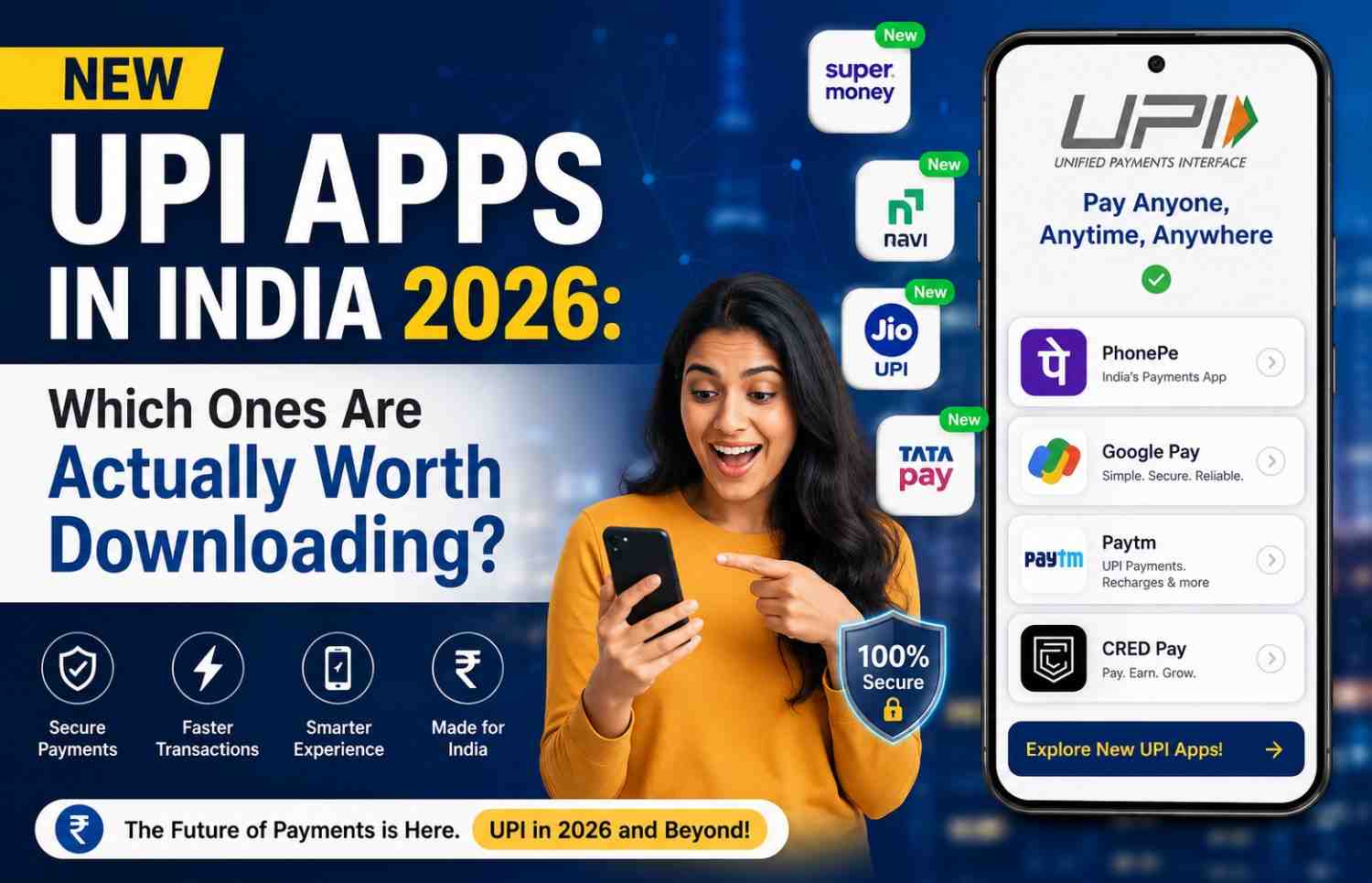
Every few months, a new UPI app launches in India with the same promise: faster payments, better rewards, cleaner design. Some genuinely add value. Others are marketing exercises with a UPI overlay that duplicates what Google Pay or PhonePe already does.
This guide walks through the new UPI apps in India worth considering in 2026, what sets them apart from the established Big Four, and how to pick one that earns its place on your phone.
Which New UPI Apps Have Entered the Market Recently?
- Stashfin: Broader financial services app that combines UPI, credit card bill payment, and consumer bill payment (gas, electricity, mobile, DTH, FASTag) with personal loans, corporate bond investments, digital gold, credit reports, and insurance. Positioned as a full financial dashboard rather than a single-purpose UPI app.
- Slice: Transitioned to a small finance bank after its merger; now offers a full-featured UPI and banking app with a credit-first orientation. UPI, savings, and Slice card in one interface.
- Fi Money: Neobank UPI app with an integrated savings account, expense tracking, and mutual fund investments. Clean interface aimed at salaried millennial users.
- Jupiter: Similar neobank play; UPI plus federal bank-backed savings, spending analytics, and credit card. Popular among users who want a banking replacement rather than a UPI overlay on their existing bank.
- Kiwi: Built specifically for a RuPay credit card on UPI. Lets you spend from a credit card while making UPI payments, useful for cardholders whose UPI merchant transactions were previously routed only through debit accounts.
- Uni Cards: Similar credit-card-on-UPI play; combines a virtual credit card with a UPI-first payment experience.
- WhatsApp Pay: Rolled out to a significantly wider user base in 2025-2026, though still lighter on features than dedicated UPI apps.
- Freo: Combines UPI, savings, and a credit line inside one app. Targets users who want to borrow small amounts within the same app they use for payments.
- CRED: Expanded from purely credit card bill payment into UPI, mutual fund investments, and rent payment; the core rewards-focused proposition remains the anchor.
Which New UPI Apps Are Actually Worth Downloading?
Download a new UPI app if:
- You want consolidated bill payment, financial services, and lending on one platform. Stashfin combines UPI, credit card bill payment, utility bill payment, personal loans, investments, and insurance
- You want a credit card on UPI setup; Kiwi or Uni Cards make sense
- You want a neobank experience combining banking, UPI, and analytics in one interface: Fi Money or Jupiter
- You want a credit line inside your payments app, Freo or Slice
- You want CRED-style rewards specifically on credit card payments, CRED
Don’t download a new UPI app if:
- You already have Google Pay or PhonePe set up and use only basic UPI functions; the marginal benefit is minimal
- The new app duplicates what your bank’s UPI app already offers; you are adding an interface without solving a problem
- The app promises “rewards on every payment” without disclosing the reward calculation transparently; the numbers rarely work out on close inspection
For most Indian users in 2026, the practical shortlist is two apps: one dedicated UPI app (Google Pay, PhonePe, or a bank UPI app) and one broader financial services app (Stashfin for consolidated bill payments, personal loans, and investments, or CRED for rewards-focused credit card payments). Two apps that cover complementary needs, not four apps that duplicate each other.
Also Read: How to Use ChatGPT for Online Blogging Without Losing Originality
What Features Should You Look for in the Best UPI App?
Six features separate a UPI app worth keeping from one that just adds to the app drawer:
- Zero platform fees on standard UPI transactions and bill payments. Any app charging user-side fees on UPI is not competitive at its core.
- UPI Lite, UPI Auto Pay, and UPI Link support in one interface. The three main UPI variants serve different payment types; a full-featured app supports all of them.
- BBPS integration for bill payment. If the app cannot pay your gas, electricity, and credit card bills through BBPS, it is a partial solution at best.
- Multi-card and multi-account dashboard. Ability to switch source accounts and manage multiple cards in one place.
- Reliable reminders and transaction history. Alerts three days before due dates, and a searchable, downloadable transaction record.
- Adjacent financial services. For users who want more than payments, investments, credit reports, insurance, and personal loans, a broader financial services app removes the need to juggle multiple apps.
The best UPI app for you meets as many of these criteria as your usage actually demands. A single-purpose UPI app like BHIM or Google Pay handles the first four cleanly. An app like Stashfin also delivers the fifth and sixth by combining UPI with bill payment across every major category, along with a full financial services layer.
How Do New UPI Apps Compare With Established Ones?
The established Big Four, Google Pay, PhonePe, Paytm, and BHIM, handle most Indian UPI transaction volume in 2026. New apps compete on three fronts:
- Consolidation across categories: Broader financial services apps like Stashfin combine UPI with bill payment, lending, investments, credit reports, and insurance, replacing what would otherwise sit across four to five separate apps
- Feature depth: Neobank apps like Fi Money and Jupiter bundle UPI with banking analytics and investment tools that the Big Four do not offer as tightly integrated
- Category focus: Kiwi and Uni Cards specialise in credit-card-on-UPI, which the Big Four support but do not centre on
In terms of raw transaction speed, security, and reliability, established and new apps are functionally equivalent because they all run on NPCI’s UPI infrastructure. The real differentiation is at the interface layer and in what else the app does around the payment.
Are Broader Financial Services Apps Better Than Pure UPI Apps?
Different, not always better; the honest answer depends on how many financial products a user actually manages.
Someone who only pays bills through UPI and does nothing else digitally is well served by Google Pay, PhonePe, or a bank UPI app. Adding a broader financial services app in that case would create clutter without solving anything.
Someone who pays bills through UPI, also holds a credit line, invests in bonds or mutual funds, checks their credit score periodically, and pays insurance premiums monthly has a legitimate case for consolidating everything into a single app.
Stashfin is one of the leading examples of this in 2026; the same app handles credit card bill payment, gas across 40+ piped operators (MGL, MNGL, Gujarat Gas, GAIL, Adani, and others) plus Indane, Bharat Gas, and HP LPG, electricity, mobile, DTH, FASTag, and broadband. These alongside personal loans with flexible tenure up to 42 months, corporate bond investments up to 14.5% p.a. via SEBI-registered OBPPs (GripInvest, Aspero), 24K digital gold, free CIBIL score checks, and insurance products covering loan protection, wallet security, and travel.
Consolidation matters when a household holds more than about 3 financial products. Below that, single-purpose apps work well. Above that, opening five apps every month for what could be consolidated into one dashboard creates real friction.
Not Every New App Belongs on Your Phone
The pace of new UPI apps launching in India is not a signal to download more. It is a signal to think carefully about which ones actually earn a place on your phone.
For most Indian users in 2026, the practical setup is two apps: one for standard UPI transactions (Google Pay, PhonePe, or a bank UPI app), and one for the specific need your primary app does not handle. If that need is rewards, CRED. If it is a credit card on UPI, Kiwi or Uni Cards. If it is consolidated bill payment plus personal loans, investments, credit reports, and insurance in one dashboard, Stashfin.
Two apps that cover complementary needs beat five apps that duplicate each other. Pick the second app based on what the first one does not do, not based on which app has the loudest marketing that week.
About the Author