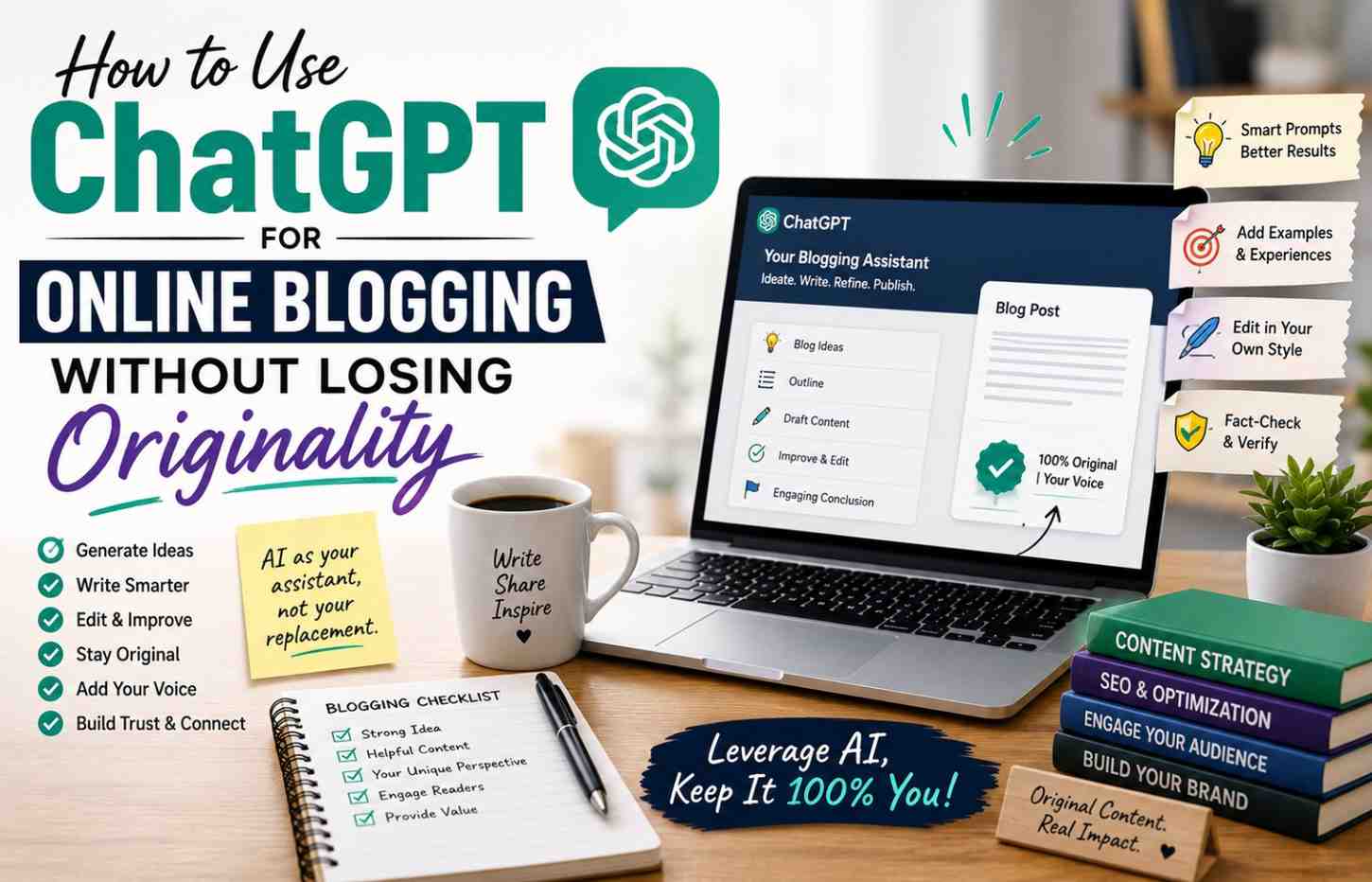
Artificial Intelligence has changed the way people approach online blogging. Among the many AI tools available today, ChatGPT has become one of the most popular assistants for bloggers, marketers, entrepreneurs, and content creators. It can generate ideas, create outlines, improve grammar, suggest headlines, and even help optimize content for search engines.
However, one concern continues to grow: How can bloggers use ChatGPT without losing their originality?
Google continues to reward content that demonstrates Experience, Expertise, Authoritativeness, and Trustworthiness (E-E-A-T). Simply copying AI-generated text and publishing it is unlikely to create long-term success. Instead, successful bloggers use ChatGPT as a creative assistant—not as a replacement for their own knowledge and personality.
This guide explains how to use ChatGPT effectively while keeping your content authentic, engaging, and SEO-friendly.
Why Originality Matters in Online Blogging
Readers don’t visit blogs just for information—they come for perspectives, experiences, and practical solutions.
Thousands of AI-generated articles are published every day. If your blog sounds exactly like everyone else’s, visitors have little reason to return.
Original content helps you:
- Build trust with readers
- Improve search engine rankings
- Increase engagement and sharing
- Develop a recognizable writing style
- Establish authority in your niche
Whether you’re writing on fsiBlog, one of the growing multi-blogging platforms, or managing your own website, originality remains your greatest competitive advantage.
Use ChatGPT as an Assistant, Not the Author
One of the biggest mistakes bloggers make is asking ChatGPT to write an entire article and publishing it without editing.
Instead, use it to support your writing process.
ChatGPT can help you:
- Generate blog topic ideas
- Create article outlines
- Brainstorm introductions
- Simplify complex concepts
- Suggest FAQs
- Improve grammar
- Rewrite awkward sentences
- Generate SEO-friendly titles
- Create meta descriptions
The final article should always reflect your own knowledge, opinions, and experiences.
Add Your Personal Experience
The easiest way to make AI-assisted content unique is by including your own experiences.
Instead of writing:
“ChatGPT helps improve blogging productivity.”
Write something like:
“After using ChatGPT for several months, I found that it reduced my research time significantly. Instead of spending two hours creating an outline, I now complete the first draft in less than thirty minutes, allowing more time for editing and fact-checking.”
Personal examples make your content impossible to duplicate.
Always Fact-Check AI Responses
Although ChatGPT is an excellent writing assistant, it can occasionally provide outdated or inaccurate information.
Before publishing:
- Verify statistics
- Check dates
- Confirm product details
- Review technical information
- Validate external references
Accurate information builds credibility and improves user trust.
Create Your Own Voice
Many AI-generated articles sound formal and repetitive.
Develop a writing style that readers recognise.
You can:
- Use conversational language
- Share opinions
- Include storytelling
- Ask questions
- Add humour where appropriate
- Use examples from real situations
Readers connect with human personalities—not robotic writing.
Use AI for SEO, Not Keyword Stuffing
Modern SEO is no longer about repeating keywords.
Instead, focus on creating content that genuinely answers search intent.
ChatGPT can help generate:
- Related keywords
- Long-tail keywords
- Semantic keywords
- FAQ ideas
- Internal linking suggestions
- Meta titles
- Meta descriptions
For example, if your primary keyword is Online Blogging, naturally include related phrases like:
- blogging tips
- content marketing
- AI writing tools
- blog SEO
- content strategy
- digital publishing
Natural keyword placement improves readability and rankings.
Rewrite Every AI Draft
Never publish the first AI response.
Instead:
- Rewrite introductions
- Change sentence structure
- Replace generic examples
- Add original insights
- Remove repetitive phrases
- Improve transitions
Editing transforms average AI content into valuable human-written content.
Many successful bloggers spend more time editing than generating content.
Add Original Research
Google increasingly rewards content containing unique information.
Consider adding:
- Survey results
- Case studies
- Customer feedback
- Personal experiments
- Screenshots
- Original images
- Charts
- Industry observations
Even small pieces of original research make your article more valuable than hundreds of similar AI-generated posts.
Use ChatGPT for Content Planning
ChatGPT works exceptionally well during the planning stage.
Ask it to generate:
- Monthly content calendars
- Keyword clusters
- Topic ideas
- Content gaps
- Blog series
- Pillar page ideas
This helps maintain consistency while allowing you to write the actual articles yourself.
Also Read: How To Choose The Right Personal Loan Based On Your Financial Situation
Keep Your Brand Personality
Every successful blog has its own identity.
Your readers should immediately recognise your writing.
Maintain consistency in:
- Tone
- Vocabulary
- Formatting
- Examples
- Storytelling style
- Visual branding
AI should support your brand—not replace it.
Avoid Overusing AI Phrases
Readers often recognise common AI expressions.
Examples include:
- “In today’s fast-paced digital world…”
- “It’s important to note…”
- “Unlock the power of…”
- “Let’s dive in…”
- “Whether you’re a beginner or expert…”
Replace these with natural introductions that reflect your own style.
Fresh writing feels more authentic.
Combine AI with Human Creativity
The best bloggers combine the efficiency of AI with human creativity.
A practical workflow looks like this:
- Research the topic.
- Use ChatGPT to generate an outline.
- Write the first draft in your own words.
- Use AI to improve grammar and clarity.
- Add personal insights and examples.
- Optimize for SEO.
- Proofread before publishing.
This approach saves time while maintaining originality.
Publish on the Right Blogging Platform
Great content deserves a platform that supports visibility and growth.
Publishing on fsiBlog, a multi-blogging platform, allows creators to share content across multiple niches while reaching a broader audience. Whether your focus is technology, business, education, finance, travel, or digital marketing, combining high-quality human content with smart AI assistance can improve both reader engagement and search performance.
Remember, platforms can help distribute your content, but originality is what keeps readers coming back.
Common Mistakes to Avoid
Many bloggers unknowingly reduce the quality of their AI-assisted content.
Avoid these mistakes:
- Publishing AI-generated text without editing
- Copying content from multiple AI tools
- Ignoring fact-checking
- Using excessive keywords
- Writing without personal insights
- Relying entirely on AI for research
- Creating generic introductions
- Forgetting to update older articles
Small improvements can significantly enhance content quality.
Final Thoughts
ChatGPT is one of the most powerful tools available for online blogging, but its true value lies in how you use it. Rather than replacing your creativity, it should enhance your workflow by helping you research, organize ideas, and refine your writing.
Originality remains the foundation of successful blogging. By combining AI efficiency with your own experiences, opinions, and expertise, you can create content that is engaging, trustworthy, and aligned with Google’s Helpful Content and E-E-A-T guidelines.
Treat ChatGPT as your writing partner—not your replacement. The bloggers who embrace this balanced approach will continue to build stronger audiences, improve search rankings, and establish lasting credibility in the ever-evolving digital landscape.
Frequently Asked Questions (FAQs)
1. Is it okay to use ChatGPT for blogging?
Yes. Using ChatGPT for brainstorming, outlining, editing, and SEO optimisation is perfectly acceptable, provided the final content is reviewed, fact-checked, and enriched with your own insights.
2. Will Google penalise AI-generated blog content?
Google does not penalise content simply because AI was used. It evaluates content based on quality, usefulness, originality, and whether it satisfies user intent.
3. How can I make AI-assisted content more original?
Add personal experiences, unique examples, original research, updated information, and rewrite AI-generated drafts in your own voice.
4. Can ChatGPT help with SEO?
Yes. ChatGPT can assist with keyword research, content outlines, meta titles, meta descriptions, FAQs, and semantic keyword suggestions, but human review is essential.
5. Which blogging platform is suitable for publishing AI-assisted content?
You can publish on platforms like fsiBlog or your own website, provided your content is original, valuable, well-edited, and designed to help readers rather than simply generate traffic.
About the Author