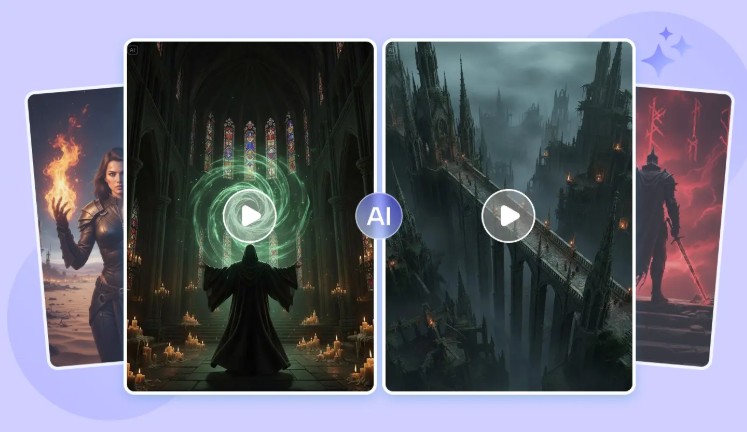
Fantasy, science fiction, and entirely invented worlds have always lived in the imagination until a filmmaker with a massive budget could make them tangible on screen. A creator with a clear vision of an alien landscape, a magical kingdom, or a post-apocalyptic society used to be stuck describing it to other people and hoping they could execute that vision.
The gap between imagination and reality was expensive and required specialized skills. Text to video technology, particularly with Dreamina’s Seedance 2.5 model, has narrowed that gap considerably, allowing a creator’s imaginary world to move from internal vision to generated footage without needing a studio, a VFX team, or a budget that doesn’t exist.
Why imaginary worlds are harder to fake than reality
Paradoxically, showing something impossible is often more convincing than showing something real. A viewer’s brain has a built-in reality detector for the everyday — if a kitchen doesn’t look quite right, if lighting behaves strangely, if physics seems off, they notice immediately. But for impossible things, a viewer’s brain has no reference point. It can only judge whether the impossible thing is internally consistent, whether the rules of that world are applied consistently, whether the details feel deliberate rather than accidental.
This actually favors generated worlds over filmed ones. A generated world can be perfectly consistent because there’s no unexpected real-world element that breaks the rules. Every detail can serve the logic of the world being built. This makes imaginary worlds surprisingly easier to render convincingly than realistic ones, as long as the creator has thought through what the rules of that world are.
Details as worldbuilding tools
The small, specific details of a world are what make it feel inhabited and real. Not just “there are creatures,” but “the creatures are reptilian, move with a sideways gait, communicate through color changes in their skin.” Not just “there’s a city,” but “the city is built vertically along cliff faces, connected by bridges made of woven plant material, lit by bioluminescent sources at night.” These specifics create a world that feels thought-through and lived-in.
Consistency as the foundation of believability
An imaginary world can break every law of physics and still feel real if it breaks them consistently. A prompt can describe rules that don’t exist in reality — “gravity here is weaker, so creatures move with longer, floating strides” — and the generation will execute that consistently throughout, making the impossible feel normal within its own context.
From imagination to visualization
Step 1: Establish the world’s rules before describing the scene
Visit Dreamina, sign in, and head to the “AI Video” section. Before writing a prompt about what a world looks like, articulate the rules of that world. How does physics work? What’s the primary light source? How do inhabitants move and communicate? What materials exist? Once those rules are clear, click “Add reference image” if you have conceptual art or visual references that capture the world’s essence. Write a detailed prompt that shows the world through a specific moment or location within it.
A detailed prompt for a 30-second sequence might read: A character walks normally along the side of a floating stone pillar, gravity bending to face the surface — bioluminescent plants spiral with the shifted pull, twin suns cast overlapping amber and blue shadows. Deeper in, spiraling architecture reveals how inhabitants built around this impossible gravity — wondrous and disorienting in equal measure.
Step 2: Choose Seedance 2.5 to render your world’s logic
With your world’s rules established and your prompt capturing a moment within it, select the Seedance 2.5 model for generation. Choose your video length based on how much of the world needs to be revealed — 30 seconds for a specific location, longer for a more expansive exploration. Pick an aspect ratio suited to where it will be shared — 16:9 for a portfolio or world showcase, 9:16 for social platforms. Click Dreamina’s generation icon and watch your imaginary world become tangible footage.
Step 3: Refine the world’s consistency before sharing
Use Dreamina’s AI editing tools to ensure the world remains internally consistent. Upscale sharpens fine details that establish the world’s rules — the way gravity affects movement, the behavior of light sources, the texture of impossible materials — while Generate Soundtrack adds ambient audio that reinforces the world’s unique atmosphere. Review the generated footage to confirm that the world’s logic holds throughout. If something breaks the internal rules, targeted editing can fix specific moments without regenerating everything. Once the world feels coherent and believable, export and share it.
Also Read: Which GIPMC Certifications Are Most Valuable for Professionals Switching Careers?
What makes Seedance 2.5 built for generating imaginary worlds
Seedance 2.5 was designed to understand and execute the kind of internally consistent, detailed worldbuilding that makes imaginary settings feel genuinely inhabited rather than hastily assembled.
Visual consistency that maintains world logic
Cumulative errors that used to cause worlds to shift and change across a sequence are largely resolved, which means the rules of an imaginary world stay consistent from opening to closing frame. If the sky is purple with three moons, it stays that way. If creatures move with a particular gait, they maintain it. This consistency is what separates a convincing imaginary world from one that feels like it’s being improvised.
- An alien landscape maintains its rules of physics and light throughout
- Creatures and inhabitants behave according to established patterns
- Architecture and environment stay true to their internal logic
Realism rendered from impossible premises
The flat, synthetic “AI look” that made earlier generated content feel artificial has been noticeably reduced. This matters enormously for imaginary worlds because any hint of artificiality breaks the spell. When an impossible world is rendered with genuine visual weight and texture, it feels real within its own context.
- Impossible materials look tactile and believable
- Alien lighting behaves with natural convincingness
- Strange creatures move with authentic physicality rather than stiff animation
Enough runway to let a world reveal itself
Single-clip generation has doubled to 30 seconds, and Ultra-long Video Generation mode extends to 180 seconds, which means a world can be explored and revealed gradually rather than being compressed into a single moment. Atmosphere and worldbuilding benefit enormously from duration — a viewer needs time to absorb an imaginary world, to understand its rules, to believe in it.
- Extended sequences allow viewers to acclimate to impossible rules
- Camera movements can reveal a world’s geography and logic gradually
- Complex environments can be explored without feeling rushed
Multimodal input for complex, layered worlds
The model accepts up to 50 pieces of multimodal material at once, meaning a world concept can be informed by reference images, conceptual artwork, detailed descriptions, and specifications about how the world works, all informing a single generation. This unified input creates worlds with genuine depth rather than surface-level strangeness.
- World descriptions work alongside visual references
- Conceptual rules can be applied consistently
- Multiple aspects of the world inform each generation
When imagination becomes real
The most compelling imaginary worlds are the ones that feel inhabited, that follow rules, that have been thought through completely. With Dreamina and its Seedance 2.5 model, a creator’s fully imagined world no longer has to remain internal.
Text to video technology makes it possible to move a world from imagination directly to screen, complete with all the specific details and consistent logic that make it feel genuinely real despite being entirely impossible.