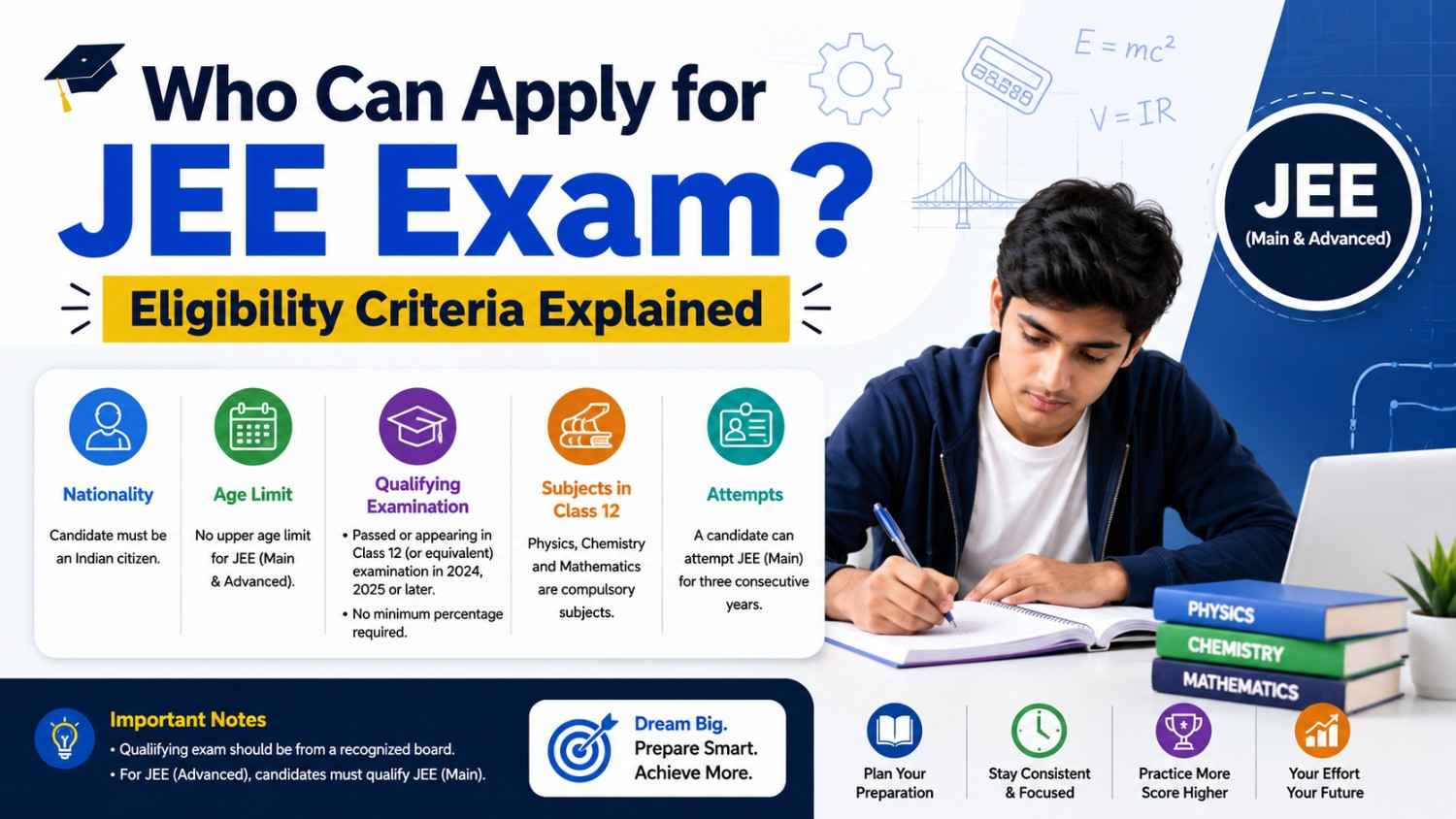
The Joint Entrance Examination (JEE) is one of India’s most prestigious engineering entrance exams. Every year, lakhs of students appear for JEE to secure admission into top engineering institutes such as IITs, NITs, IIITs, and other centrally funded technical institutions.
However, before starting your preparation journey, it is important to understand whether you are eligible to apply for the exam. Many students often have questions regarding age limits, educational qualifications, number of attempts, and minimum marks requirements.
In this comprehensive guide, we will explain who can apply for the JEE Exam, covering the eligibility criteria for both JEE Main and JEE Advanced.
What is JEE?
JEE is divided into two stages:
1. JEE Main
JEE Main is conducted by the National Testing Agency (NTA) and serves as the gateway to:
- National Institutes of Technology (NITs)
- Indian Institutes of Information Technology (IIITs)
- Government Funded Technical Institutes (GFTIs)
- Eligibility for JEE Advanced
2. JEE Advanced
Candidates who qualify JEE Main can appear for JEE Advanced, which is required for admission to the prestigious Indian Institutes of Technology (IITs).
JEE Main Eligibility Criteria
Let’s understand the eligibility requirements for JEE Main.
1. Educational Qualification
Students must have passed or be appearing in:
- Class 12 (10+2) examination from a recognized board.
- Equivalent qualifying examination approved by educational authorities.
Eligible candidates include those who have studied from:
- CBSE
- ICSE
- State Boards
- National Institute of Open Schooling (NIOS)
- Other recognized educational boards
Mandatory Subjects
Candidates should have studied:
- Physics
- Mathematics
- One of Chemistry/Biology/Biotechnology/Technical Vocational Subject
These subjects are essential for admission to engineering programs through JEE.
2. Year of Passing Class 12
Candidates who have passed Class 12 in the eligible years specified by NTA can apply.
For example, if the examination is conducted in 2026, students who passed Class 12 in recent eligible years or are appearing in 2026 may apply.
Applicants should always verify the latest notification issued by NTA before filling out the application form.
3. Age Limit for JEE Main
One of the biggest advantages of JEE Main is that:
There is no age limit for appearing in JEE Main.
Students of any age can apply, provided they meet the educational qualification requirements.
However, individual institutes may have their own age-related admission policies. Therefore, candidates should check institute-specific guidelines while applying.
4. Number of Attempts
A candidate can appear for JEE Main for:
Three consecutive years
Since JEE Main is generally conducted twice a year (January and April sessions), students can take multiple attempts during the eligible period.
The best score among attempts is often considered for ranking purposes.
JEE Advanced Eligibility Criteria
Students aiming for admission into IITs must satisfy additional eligibility requirements.
1. Qualifying JEE Main
The first requirement is:
Candidate must qualify JEE Main.
Only the top-performing candidates based on the JEE Main ranking are eligible to appear for JEE Advanced.
Meeting the JEE Main cutoff is mandatory.
2. Age Limit for JEE Advanced
Candidates should satisfy the age criteria announced by IIT authorities.
Generally:
- Candidates should be born on or after the specified date mentioned in the official notification.
- Relaxation is usually provided to reserved category candidates.
Since age requirements may change, candidates must refer to the latest JEE Advanced information brochure.
3. Number of Attempts in JEE Advanced
Candidates can generally attempt JEE Advanced:
Maximum two times in two consecutive years.
For example:
- First attempt after Class 12
- Second attempt in the following year
After exhausting the permitted attempts, candidates become ineligible for JEE Advanced.
4. Class 12 Qualification Requirement
Candidates must have:
- Appeared for Class 12 examination for the first time in the prescribed year.
- Passed the qualifying examination from a recognized board.
The exact qualifying year changes according to the examination cycle, so applicants should always verify the official notification.
5. Previous Admission Restrictions
A candidate may not be eligible if:
- Already admitted to an IIT under certain conditions.
- Previously accepted admission at an IIT and continued the program.
Specific admission-related rules are clearly mentioned in the official JEE Advanced guidelines.
Minimum Percentage Required for JEE
Many students ask:
“Is there a minimum percentage required in Class 12 for JEE?”
For appearing in JEE Main:
- NTA generally does not prescribe a specific minimum percentage for appearing in the exam.
However, for admission into institutes:
- Eligibility requirements may vary.
- Institutes may consider Class 12 performance according to their admission policies.
Candidates should regularly check official notifications for the latest updates.
Can Diploma Students Apply for JEE?
Yes.
Students holding a recognized diploma can apply for JEE Main.
However:
- Admission opportunities may differ depending on the institution.
- Eligibility for JEE Advanced should be verified through the official brochure.
Diploma students planning to pursue engineering through national-level institutes should carefully review admission requirements.
Can Droppers Apply for JEE?
Absolutely.
Students who have taken a gap year after Class 12 can apply for JEE Main and JEE Advanced, provided they meet the applicable attempt and eligibility criteria.
Many successful IITians and NIT students have secured admission after taking a dedicated preparation year.
Can Foreign Nationals Apply for JEE?
Yes.
Foreign nationals and overseas candidates can apply under specific categories and admission procedures.
Separate guidelines may apply regarding:
- Application process
- Eligibility
- Admission criteria
- Fee structure
Candidates should refer to official JEE and institute notifications for accurate details.
Also Read: Why fsiBlog is the Future of Multi-Niche Blogging Platforms
Important Documents Required for JEE Application
While filling out the application form, candidates generally need:
- Class 10 mark sheet
- Class 12 mark sheet (if available)
- Passport-size photograph
- Signature
- Identity proof
- Category certificate (if applicable)
- PwD certificate (if applicable)
Ensure all documents are uploaded according to prescribed specifications.
Common Mistakes Students Should Avoid
Many applicants face issues due to simple errors.
Avoid:
- Entering incorrect personal details
- Uploading wrong documents
- Selecting incorrect category
- Missing application deadlines
- Ignoring official notifications
Always cross-check information before submitting the application form.
Final Thoughts
The JEE Exam opens doors to some of India’s most respected engineering institutions. Understanding the eligibility criteria beforehand helps students avoid application mistakes and prepare confidently.
In summary:
- Class 12 passed or appearing students can apply.
- There is no age limit for JEE Main.
- Candidates can attempt JEE Main for three consecutive years.
- JEE Advanced requires qualification in JEE Main.
- Additional rules regarding age, attempts, and previous admissions apply for IIT admissions.
Before applying, always refer to the latest official notifications released by NTA and IIT authorities, as eligibility rules may be updated from time to time.
Students who meet the criteria and prepare strategically can take a significant step toward achieving their dream of studying at an IIT, NIT, IIIT, or other top engineering institution.
Visit fsiBlog for related blogs …
About the Author